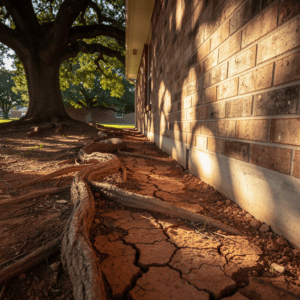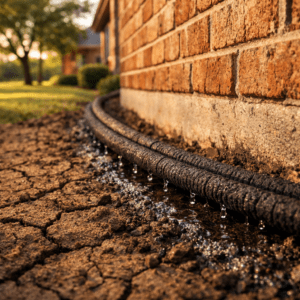
When most North Texas homeowners think about foundation problems, they think about dry weather. The brutal summer droughts, the cracked clay soil pulling away from the foundation perimeter, the soaker hose recommendations. That narrative is accurate and important.
What gets far less attention is the other half of the problem: too much water in the wrong place at the wrong time.
Poor drainage around a residential foundation is one of the most common and most preventable causes of foundation damage in Tarrant, Wise, and Parker Counties. When water cannot drain away from your home effectively, it pools against the foundation, saturates the clay soil unevenly, creates the differential moisture conditions that drive foundation movement, and in some cases infiltrates the crawl space or finds its way beneath the slab.
The good news is that drainage problems are among the most correctable foundation risk factors available to homeowners. You do not need to accept poor drainage as a permanent condition. This guide covers every major drainage solution available, from the simplest and least expensive fixes to comprehensive drainage systems, and helps you identify which ones apply to your specific situation.
Why Drainage Matters as Much as Drought in North Texas
Foundation movement in North Texas is driven by moisture imbalance, not moisture in absolute terms. The clay soil beneath and around your home does not care whether it is getting too much water or too little. What it responds to is the difference between wet zones and dry zones. When one section of the foundation soil is saturated while another is bone dry, the foundation above experiences differential forces that ultimately produce cracking and displacement.
Poor drainage creates exactly this condition. Rain or irrigation water that pools against one corner of the foundation saturates the clay in that zone. The clay swells. That section of the foundation is pushed upward while the rest remains at its original position. Over time, the stress fractures the concrete or shifts the pier system.
This is why drainage is not a separate concern from foundation health. It is the same concern, approached from the opposite direction.
The First Line of Defense: Grading
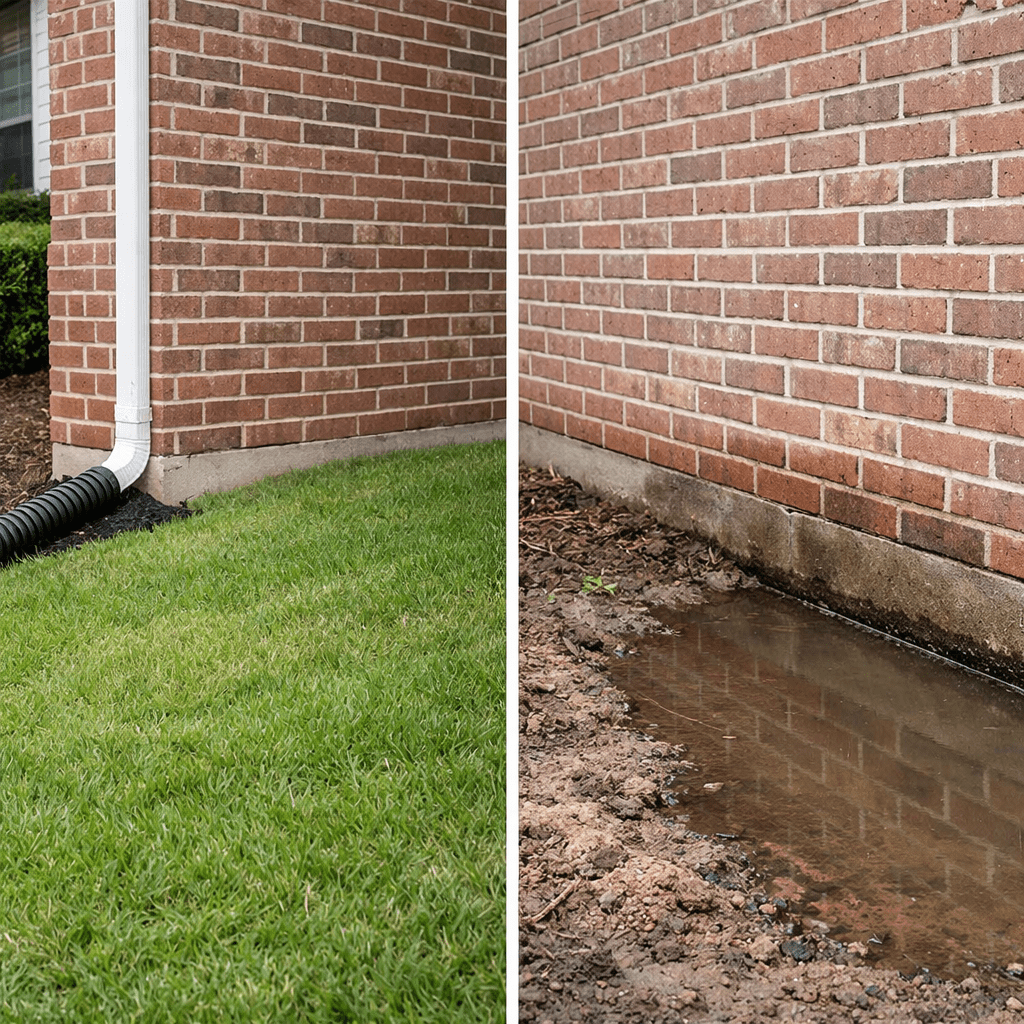
Grading is the slope of the soil around your home’s foundation. Correct grading directs water away from the structure. Incorrect grading allows water to run toward the foundation or pool against it.
The standard recommendation from structural engineers and building codes is a minimum of 6 inches of drop in elevation over the first 10 feet from the foundation. This slope ensures that water from rain, irrigation, or neighboring drainage paths moves away from the structure rather than accumulating against it.
Over time, grading degrades. Soil settles, landscaping beds fill in with mulch that raises the grade near the foundation, and erosion from heavy rain events gradually reshapes the yard’s drainage profile. Many North Texas homes that were properly graded at construction have developed drainage problems simply through normal soil settling and landscape accumulation over 10 to 20 years.
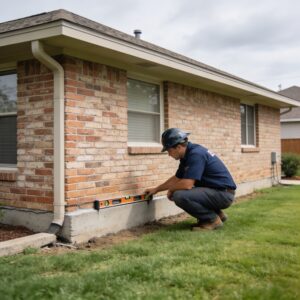
How to check your grading: After a significant rain event, observe where water collects. If you see puddling along any section of your foundation perimeter, or if water flows toward the home rather than away from it, regrading is needed.
How grading is corrected: For minor issues, adding topsoil and shaping the grade by hand is a manageable project. For significant grading deficiencies, especially around older homes where the landscaping has settled considerably, professional regrading with compacted fill is the appropriate solution.
Gutters and Downspouts: The Most Overlooked Drainage System
Your gutters and downspouts are a drainage system for the entire roof surface of your home. Every square foot of roof during a rain event is collecting and funneling water. Where that water goes when it leaves the downspout matters enormously for foundation health.
Common gutter and downspout problems that damage foundations:
Clogged gutters that overflow during rain events deposit concentrated water directly against the foundation at the overflow point. This is particularly damaging because roof overflows tend to occur in the same location repeatedly, creating a chronic saturation zone in the clay soil at that corner of the home.
Downspouts that terminate too close to the foundation release all of the roof water directly adjacent to the foundation perimeter. Standard downspouts terminate at grade level. Without an extension, that is often within 12 to 18 inches of the foundation, which is nowhere near far enough for North Texas clay soil conditions.
Disconnected or cracked downspouts release water at unexpected points, sometimes against the foundation wall or into areas that funnel water toward the structure.
Solutions:
Downspout extensions are the simplest and least expensive drainage improvement available. Extending each downspout with a rigid or flexible discharge tube to a point at least 4 to 6 feet from the foundation moves the water discharge volume far enough away to prevent saturation of the immediate foundation soil. In many cases, extensions of 8 to 10 feet are appropriate where the grade is relatively flat.
Underground downspout drainage routes the downspout discharge through a buried pipe to a discharge point at the property edge, a dry well, or a drainage swale. This is a more substantial improvement that works well in situations where surface extension tubes are not practical because of landscaping, sidewalks, or aesthetic concerns.
Regular gutter maintenance is not optional in North Texas. Clean gutters at minimum twice per year: in late fall after leaf drop and in spring before the heavy rain season. Homes under significant tree canopy may need quarterly cleaning.
Surface Drainage: Swales, Berms, and Grading Channels
When water from neighboring properties, streets, or higher-elevation areas of your yard consistently flows toward your foundation, surface grading alone may not be sufficient. Swales and berms redirect surface water flow before it reaches the foundation zone.
Swales are shallow, gently sloped channels cut into the yard that direct water away from the home and toward an appropriate discharge point such as the street, a storm drain, or a low-lying area of the property away from the structure. A well-designed swale intercepts water that would otherwise flow toward the foundation and redirects it before it can saturate the perimeter soil.
Berms are low earthen mounds installed upslope of the foundation to redirect surface flow around rather than toward the structure. They work similarly to swales but through elevation rather than channeling.
Both swales and berms require careful design to ensure that redirected water discharges appropriately and does not create new drainage problems elsewhere on the property or on neighboring lots.
Subsurface Drainage: French Drains and Interior Systems
When surface solutions are insufficient to manage the volume of water reaching the foundation, subsurface drainage systems address water that has already entered the soil.
Exterior French drain systems are perforated pipes buried in a gravel-filled trench at the base of the foundation perimeter. They intercept water as it percolates down through the soil and route it away from the foundation zone before it can accumulate at the footing level. French drains are particularly effective for homes that experience chronic soil saturation along one or more sides despite having adequate surface grading.
Installation involves excavating a trench alongside the foundation, placing a geotextile fabric liner, filling with clean gravel, embedding the perforated drain pipe, and covering with additional gravel before backfilling. The discharge end of the pipe routes to daylight at a lower point on the property, to a dry well, or to a storm drain connection.
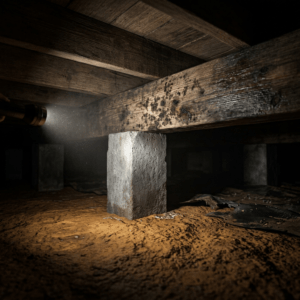
Interior crawl space drainage is specific to pier and beam foundations where water infiltrates the crawl space. An interior perimeter drain installed within the crawl space collects groundwater intrusion and routes it to a sump pump for discharge outside the foundation. This is a more significant installation but is the appropriate solution for crawl spaces that experience standing water after rain events.
Window Well and Stairwell Drains
For homes with basement window wells or below-grade stairwells, dedicated drain systems at these locations prevent water accumulation in these low points from finding its way against the foundation. Window well drains connect to a gravel bed or to a subsurface drainage line. This is a targeted solution for specific vulnerability points rather than a whole-system drainage approach.
Irrigation System Management
Irrigation systems contribute significantly to foundation moisture loading if not managed correctly. Sprinkler zones along the foundation perimeter that run on the same schedule as lawn zones typically apply more water to the foundation soil than the clay can absorb and discharge between cycles.
Key irrigation management practices for foundation health:
Separate your foundation soaker hose system from your lawn irrigation system. The foundation soaker hose should run on a consistent, measured schedule specifically designed for clay moisture management. Lawn irrigation should be scheduled separately based on turf needs and rainfall, not foundation moisture targets.
Direct irrigation heads away from the foundation. Spray heads positioned to water plantings along the foundation wall frequently over-apply water to the clay soil immediately adjacent to the concrete. Adjust head direction and arc to minimize direct application against the foundation.
Install rain sensors or a smart controller that suspends irrigation during and after rain events. Many North Texas homeowners run irrigation on fixed schedules that do not account for recent rainfall, compounding moisture loading problems during wet periods.
When to Call a Professional
Some drainage problems are well within the capability of a motivated homeowner to address. Others require professional assessment and installation to be effective.
Call a professional drainage contractor or structural engineer if:
- You have chronic standing water against any section of your foundation after rain events
- Water is consistently infiltrating your crawl space
- Your yard has complex drainage patterns involving multiple water sources or neighboring property runoff
- You have already corrected obvious issues like downspouts and grading but drainage problems persist
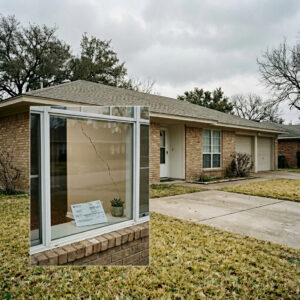
- You are experiencing foundation movement symptoms and are unsure whether drainage is a contributing factor
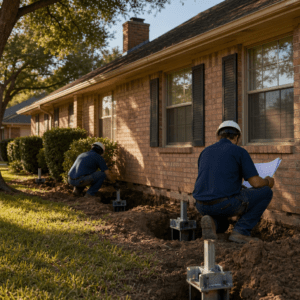
At Tri-County Foundation Repair, our engineering inspection process evaluates drainage conditions as part of the full foundation assessment. Understanding the drainage environment around your home is essential context for any foundation diagnosis, and our engineers document grading and drainage observations in every inspection report.
If you are already seeing foundation symptoms and wondering whether drainage is part of the cause, our post on Foundation Issues or Normal House Settling helps you evaluate which symptoms require professional attention and how urgently.
And if your foundation has already sustained damage and you are weighing the cost of addressing it now versus later, our breakdown of how much waiting actually costs month by month makes the financial case for acting promptly rather than hoping the problem stabilizes on its own.
Call Tri-County Foundation Repair at (817) 406-4094 or reach out through our contact form. We serve Tarrant, Wise, and Parker Counties.
Frequently Asked Questions: Foundation Drainage Solutions in North Texas
How does poor drainage damage a foundation in Texas?
Poor drainage allows water to pool or accumulate against the foundation perimeter, saturating the clay soil in that zone. North Texas clay expands dramatically when wet, which pushes upward on the foundation in the saturated area while the rest of the foundation remains at its normal position. This differential movement creates the stress that cracks slabs, shifts pier systems, and produces the interior symptoms homeowners associate with foundation damage. Poor drainage is one of the most common and most preventable contributing causes of foundation movement in Tarrant, Wise, and Parker Counties.
What is the best drainage solution for a foundation in North Texas?
The best solution depends on the specific drainage problem present. For most homeowners, the highest-impact starting points are extending downspouts at least 4 to 6 feet from the foundation, correcting yard grading to slope away from the structure at 6 inches per 10 feet, and cleaning gutters seasonally. For chronic soil saturation that persists despite surface corrections, an exterior French drain system intercepting subsurface water at the foundation perimeter is typically the appropriate next level of intervention.
How much does foundation drainage correction cost in North Texas?
Simple improvements like downspout extensions cost as little as $20 to $50 per downspout in materials. Professional regrading of a foundation perimeter typically ranges from $1,000 to $5,000 depending on the scope and the amount of fill material required. French drain installation along a foundation perimeter ranges from $3,000 to $10,000 depending on length and discharge complexity. Interior crawl space drainage systems with sump pump installation typically range from $3,000 to $8,000. These costs are significantly less than the foundation repair bills that chronic drainage problems eventually produce.
How do I know if my yard is graded correctly around my foundation?
Observe your yard after a moderate to heavy rain event. If water pools against any section of the foundation perimeter and takes more than 30 to 60 minutes to drain away, your grading is insufficient in that area. Also look for erosion channels that run toward the foundation, mulch beds built up to or above the foundation edge, and landscape features that create water collection points adjacent to the structure. A simple level and measuring tape can confirm whether you have the minimum 6-inch drop over 10 feet recommended by structural engineers.
Should downspouts drain away from the foundation?
Yes, at a minimum of 4 to 6 feet from the foundation perimeter. In North Texas, where clay soil absorbs and holds water near the foundation for extended periods after rain events, 6 to 10 feet of extension distance is preferable when practical. Underground downspout drainage routed to a discharge point at the property edge or a storm drain connection is the most effective option where surface extensions are not practical.
Can a French drain fix foundation drainage problems?
A properly designed and installed French drain can significantly reduce soil saturation at the foundation perimeter by intercepting subsurface water before it accumulates at the footing. It is most effective when installed as part of a comprehensive drainage solution that also addresses surface grading and gutters. A French drain that receives excessive surface water input without companion surface drainage improvements will eventually become overwhelmed. French drains are not a substitute for proper grading but are an effective supplement when subsurface water management is needed.
Can too much water from irrigation damage my foundation?
Yes. Over-irrigation of foundation perimeter planting beds or lawn zones adjacent to the foundation can saturate clay soil and cause localized expansion, particularly if irrigation runs on a fixed schedule that does not account for recent rainfall. The same clay soil swelling that drought causes through contraction can be caused by over-irrigation through expansion. Proper irrigation management, including rain sensors, smart controllers, and directed head placement that avoids over-application directly against the foundation, is an important component of comprehensive foundation protection.
Is foundation drainage a DIY project or do I need a professional?
Many foundational drainage improvements are within homeowner capability. Downspout extensions, minor regrading with topsoil, and gutter cleaning are straightforward projects. More substantial work such as French drain installation, interior crawl space drainage systems, and significant regrading involving gravel or compacted fill typically benefit from professional installation to ensure correct slope, discharge, and long-term function. When drainage problems are contributing to active foundation movement, a structural engineering assessment should accompany any drainage correction to ensure the full scope of the problem is understood.