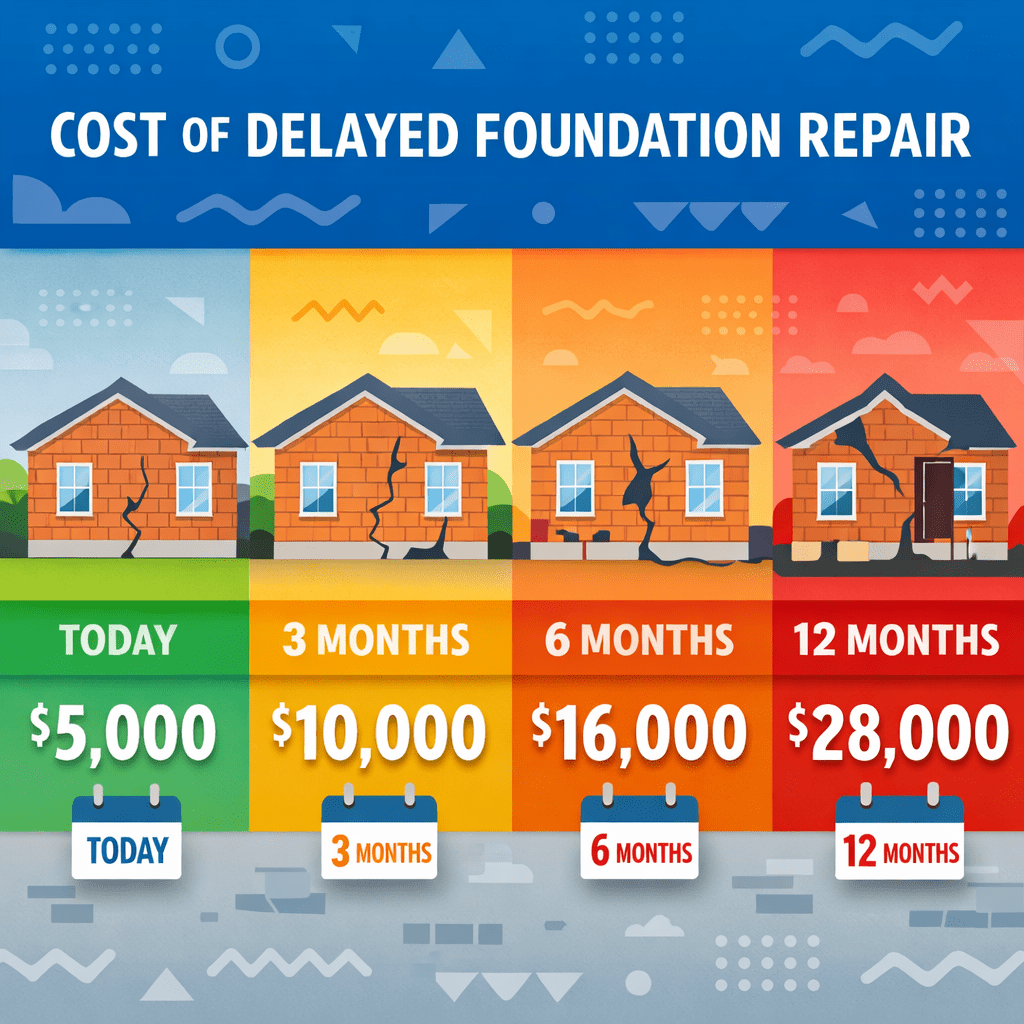
You noticed a small crack above your door six months ago. Maybe you saw it, made a mental note, and told yourself you’d deal with it “soon.” Now that crack is wider. Your doors are sticking. You’re starting to see new cracks in other rooms. Are your foundation problems getting worse?
Here’s the hard truth about foundation problems in North Texas: they don’t stabilize, they don’t improve, and waiting doesn’t save you money. In fact, every month you delay foundation repairs, the damage—and the repair cost—gets measurably worse.
After nearly two decades repairing foundations throughout Tarrant, Wise, and Parker counties, we’ve seen this pattern hundreds of times. Homeowners who address foundation issues early spend $4,000-$7,000. Those who wait a year often face $20,000-$30,000 in repairs, plus extensive interior damage, plumbing issues, and potential structural complications.
Let’s look at exactly how much waiting actually costs, with real numbers based on actual cases we’ve handled in North Texas.
Foundation Problems Getting Worse? The Foundation Problem You’re Dealing With Today
Scenario: Small crack above door, minor settling noticed
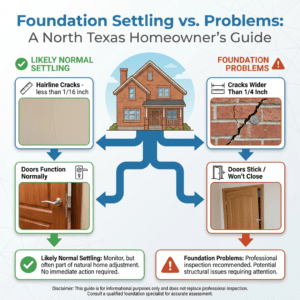
You’re seeing the early warning signs. There’s a crack running from the corner of your bedroom door toward the ceiling—maybe 1/8 inch wide and a foot long. A few doors don’t close quite as smoothly as they used to. When you look closely, you might notice your floor has a very slight slope in one area.
Current Estimated Repair Cost: $4,500-$6,500
At this stage, foundation repair typically involves:
- 4-6 foundation piers or posts needing adjustment
- Minimal structural work required
- 2-3 day repair timeline
- Limited interior damage to address
- No secondary issues like plumbing stress
What’s Actually Happening:
Your foundation has started settling in a specific area. For pier and beam homes, this usually means 4-6 support posts or beams have shifted. For slab foundations, differential settlement has created stress points in the concrete. The movement is still relatively contained to one section of your foundation.
The crack you’re seeing is your home telling you about the problem. It’s not getting better. North Texas expansive clay soil means this movement will continue and accelerate with every seasonal moisture cycle.
Three Months Later: The Problem Has Progressed
What’s Changed:
That original crack is now noticeably wider—maybe 1/4 inch. It’s also longer, extending further toward the ceiling. You’ve noticed 2-3 new cracks in other areas of the house. Multiple doors stick now, requiring effort to close. Your windows in one area of the house are harder to open.
New Estimated Repair Cost: $8,500-$11,000
The foundation problem has expanded:
- 8-10 piers or posts now need repair (nearly double the original issue)
- Foundation movement has stressed additional structural elements
- Drywall damage throughout affected areas will need repair
- Some doors may need rehinging after foundation correction
- Interior finish work required
- 3-4 day repair timeline
Why the Cost Jumped 70-90%:
Foundation problems don’t spread linearly—they accelerate. When one section of your foundation settles, it creates stress on adjacent areas. Those adjacent sections, already stressed, fail faster than the original problem area did.
In North Texas, three months means you’ve gone through most of a seasonal cycle. If the problem started in winter (wet season), summer drought has now compounded the stress. If it started in summer, winter moisture has made it worse. Either way, the wet-dry cycle of Texas weather doesn’t just continue the damage—it amplifies it.
Real Example from Weatherford:
We met a homeowner who called us three months after first noticing foundation issues. She’d been busy with work and kept putting off the call. In those three months, the number of piers needing repair had doubled from 5 to 10. What would have been a $5,800 repair became $10,200. Plus, she now needed $1,800 in drywall repairs that weren’t necessary three months earlier.
Six Months Later: Moderate to Serious Damage
What’s Changed:
Multiple cracks throughout your home, some quite wide (1/2 inch or more). Several doors won’t close at all without significant force. You can visibly see floor slopes when you place a ball on the ground—it rolls. Cabinet doors don’t align properly. You’re starting to notice gaps between your walls and ceiling in multiple rooms.
New Estimated Repair Cost: $14,000-$18,000
The foundation problem is now widespread:
- 12-15 piers or posts require repair
- Structural beams may need replacement or reinforcement
- Extensive drywall repair throughout the home
- Multiple doors need adjustment or replacement
- Plumbing joints are stressed (potential leaks developing)
- Floor refinishing may be needed in affected areas
- Windows may need adjustment
- 5-7 day repair timeline
Secondary Damage Costs:
This is where waiting gets really expensive. Beyond foundation repair itself, you’re now dealing with:
- Drywall repairs: $2,000-$3,500
- Door adjustments: $500-$1,200
- Potential plumbing repairs: $800-$2,500 if leaks have developed
- Interior paint throughout affected areas: $1,500-$3,000
Why the Cost More Than Doubled:
Six months of foundation movement in North Texas means you’ve been through two complete seasonal transitions—either winter-summer-winter or summer-winter-summer. Each transition stresses your foundation in opposite directions. Expansion, contraction, expansion, contraction. The cumulative stress is devastating.
The foundation work itself costs more because more piers or posts need addressing, but the real cost explosion comes from secondary damage. Plumbing pipes, rigid and unforgiving, have been stressed by foundation movement for six months. Small leaks may have started under your slab or in your crawl space. Drywall has cracked throughout the home. Floor joists have been stressed.
Real Example from Keller:
A homeowner noticed minor foundation issues but wanted to save up money before calling. Six months later, what started as 6 piers needing repair had become 14 piers plus beam replacement. The foundation work went from $6,200 to $16,800. But that wasn’t all—foundation movement had stressed plumbing joints, causing a slow leak under the slab that required an additional $3,200 to repair. Total bill: $20,000. If addressed initially: $6,200.
Cost of waiting six months: $13,800.
One Year Later: Extensive Structural Damage
What’s Changed:
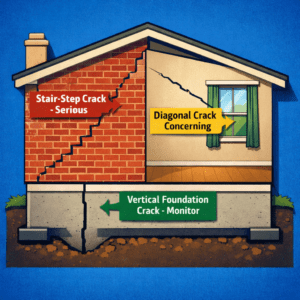
Your home has serious, visible structural problems. Large cracks in multiple locations, some wide enough to see through. Doors throughout the house malfunction. Significant floor slopes are obvious when walking. Windows won’t close properly. You can see visible separation where your walls meet the ceiling. Exterior brick may show stair-step cracking. You might notice musty smells from hidden water damage.
New Estimated Repair Cost: $22,000-$28,000+
The foundation damage is now severe:
- 18+ piers or posts need repair or replacement
- Structural beam replacement required
- Possible sill plate damage (pier and beam homes)
- Foundation sections may require complete rebuilding
- Extensive interior demolition and reconstruction
- Plumbing repairs almost certainly needed
- Electrical issues possible from structural movement
- HVAC ductwork may be damaged
- 7-10 day foundation repair timeline
- Additional weeks for interior reconstruction
Comprehensive Damage Costs:
Foundation repair: $22,000-$28,000 Plumbing repairs: $2,500-$5,000 (likely) Electrical work: $800-$2,000 (if needed) Drywall throughout home: $4,000-$7,000 Flooring repairs/replacement: $3,000-$8,000 Door replacements: $1,500-$3,000 Window adjustments: $800-$1,500 Interior painting: $3,500-$6,000 HVAC duct repairs: $1,000-$3,000 (if damaged)
Total Potential Cost: $39,000-$63,000
Why This Is Catastrophic:
A full year of foundation movement in North Texas means your home has experienced two complete wet-dry cycles. According to the Foundation Performance Association, expansive clay soil movement compounds exponentially over time rather than linearly. Each cycle doesn’t just add damage—it multiplies existing damage.
At this stage, foundation movement has likely:
- Stressed plumbing throughout the home, causing multiple leaks
- Created electrical hazards where wires have been pulled or stressed
- Damaged HVAC ductwork, causing air leaks and efficiency loss
- Made the home difficult or impossible to sell without disclosure and major repairs
- Potentially affected home insurance rates or coverage
- Created safety concerns with structural integrity
Real Example from Azle:
We received a call from a homeowner who’d noticed problems “for a while” but kept putting it off. By the time we inspected, the home had experienced a full year of progressive foundation failure.
Original problem (we could see from old photos the homeowner shared): Approximately 6 piers needed, estimated $5,200.
One year later: 22 piers needed, 3 beams requiring replacement, extensive structural work. Foundation repair: $26,800.
Secondary damage discovered: Plumbing leaks under slab ($4,500), extensive interior damage throughout home ($9,200), exterior brick repairs needed ($2,800).
Total damage: $43,300.
Cost if addressed immediately: $5,200.
Cost of waiting one year: $38,100.
The homeowner’s equity in the home was essentially wiped out. When they eventually sold two years later, the disclosed foundation history reduced the sale price by an estimated $25,000 even after repairs were completed.
Why Foundation Problems Accelerate in North Texas
The pattern you’ve just read isn’t speculation—it’s the predictable result of North Texas geology and physics.
The Texas Clay Soil Factor
North Texas sits on highly expansive clay soil that changes volume by up to 10% based on moisture content. When your foundation settles in one area, it creates differential stress. The settled section pulls on adjacent areas, stressing them beyond their design limits. Those adjacent areas then fail faster than the original section did.
It’s not a domino effect where problems spread at a steady rate. It’s an acceleration where each new area of failure happens faster than the previous one.
Seasonal Wet-Dry Cycles
Texas weather compounds the problem. Summer drought contracts soil, pulling away from your foundation and creating voids. When fall and winter rains arrive, water rushes into those voids, causing rapid soil expansion that pushes against your foundation with tremendous force. The cycle repeats every year, but each cycle affects a foundation that’s weaker than it was the previous year.
Structural Stress Multiplication
Foundation movement creates stress throughout your home’s structure. A floor joist designed to support vertical loads suddenly experiences lateral stress as the foundation shifts beneath it. Plumbing pipes designed to be stationary experience movement and flexing. Electrical conduit gets pulled. HVAC ductwork separates.
Each of these stressed components fails faster than it would under normal conditions. And when they fail, they create additional problems that multiply repair costs.
What ELSE You’re Paying For When You Wait
Beyond the direct repair costs, delaying foundation work creates hidden expenses many homeowners don’t anticipate:
Higher Utility Bills
Foundation movement creates gaps in your home’s envelope. Air conditioning escapes through cracks around doors and windows. Heating is lost through foundation gaps. Homeowners with foundation problems typically see 10-20% higher utility bills. Over a year, that’s $300-$800 in wasted energy.
Increased Insurance Premiums
Some insurance companies raise rates or even non-renew policies when foundation problems are documented but not repaired. Even if your rates don’t increase, foundation damage can complicate claims for other issues like plumbing leaks or water damage.
Pest Entry
Cracks and gaps from foundation movement create entry points for pests. Termites, rodents, and other pests exploit these openings. The cost of pest damage and treatment can run into thousands of dollars.
Water Intrusion
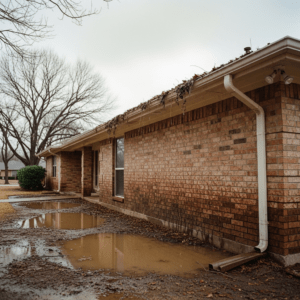
Foundation cracks allow water entry during heavy rains. This creates moisture problems, mold growth, and wood rot. Water damage remediation and mold removal can cost $3,000-$15,000 depending on extent.
Inability to Sell or Refinance
Homes with obvious foundation problems are difficult to sell or refinance. Buyers will either walk away or demand massive price reductions. Lenders may refuse to finance properties with significant foundation issues. Appraisers will reduce valuations.
We’ve seen homeowners unable to take advantage of low refinance rates because their foundation problems prevented loan approval. The lost opportunity cost of a 2% rate reduction over the remaining loan term can exceed $50,000 on a typical mortgage.
Stress and Quality of Life
There’s no dollar value for the stress of living with worsening foundation problems. The anxiety of doors that won’t close. The embarrassment when guests comment on sloping floors or cracked walls. The worry about what’s happening to your largest investment.
The Real Cost Comparison: Address It Now vs. Wait
Let’s look at the total financial impact of addressing foundation problems today versus waiting:
Scenario: Foundation Problem Identified Today
Foundation repair needed: $5,500 Secondary damage: $0 (caught early) Lost utility costs: $0 Time living with problem: Minimal Impact on home value: None (problem resolved before sale) Total cost: $5,500
Scenario: Wait 6 Months
Foundation repair needed: $15,000 Secondary damage: $3,500 (drywall, doors, minor plumbing) Lost utility costs: $300 Stress and quality of life: 6 months Impact on home value: Resolved before sale Total cost: $18,800
Additional cost of waiting 6 months: $13,300
Scenario: Wait 12 Months
Foundation repair needed: $25,000 Secondary damage: $12,000 (extensive interior, plumbing, exterior) Lost utility costs: $600 Potential pest damage: $1,500 Stress and quality of life: 12 months Impact on home value: $15,000-$25,000 reduction even after repairs (disclosure required) Total cost: $39,100+ plus reduced equity
Additional cost of waiting 12 months: $33,600+ plus lost equity
Why Homeowners Delay (And Why These Reasons Don’t Hold Up)
We hear the same reasons for delaying foundation repairs repeatedly. Let’s address them honestly:
“I’m not sure if it’s really a problem yet.”
Reality: If you’re noticing symptoms, it’s a problem. The question isn’t whether you have foundation issues—it’s how extensive they are. A $1,100 engineering inspection provides definitive answers. Avoiding that investment to “wait and see” typically costs $10,000-$20,000 in additional damage.
“I don’t have the money right now.”
Reality: You’ll have even less money six months from now when the repair costs triple. Many homeowners finance foundation repairs, and the monthly payment on $6,000 financed is far less than the monthly payment on $18,000 financed. Plus, we credit the $1,100 engineering inspection toward repair costs, making the actual investment even more manageable.
“I’m planning to sell soon anyway.”
Reality: Foundation problems severely impact your sale. Buyers will discover issues during inspections and either walk away or demand price reductions that exceed repair costs. Repairing foundation issues before listing typically increases sale prices more than repair costs, resulting in higher net proceeds.
“It’s not that bad yet.”
Reality: “Not that bad” becomes “catastrophic” faster than most homeowners imagine. In North Texas clay soil, foundation problems accelerate rather than progress steadily. What’s “not that bad” today can be “really bad” in three months and “disastrous” in six months.
“I’ll wait until it gets really bad, then address it all at once.”
Reality: This is the most expensive approach possible. “Really bad” costs 5-10 times more than “minor problem.” Plus, at “really bad,” you’re dealing with extensive secondary damage, quality of life impacts, and potential safety issues. There’s no economy of scale in foundation repair that makes waiting worthwhile.
“Maybe it will stabilize on its own.”
Reality: Foundation problems in North Texas never stabilize on their own. Our expansive clay soil guarantees ongoing movement. The wet-dry seasonal cycles ensure continuous stress. The physics of structural failure mean each damaged area creates stress on adjacent areas. Stabilization only happens after professional repair.
The Month-by-Month Timeline in Summary
Today:
- Cost: $4,500-$6,500
- Extent: 4-6 piers, minimal damage
- Timeline: 2-3 days
- Secondary damage: None
3 Months:
- Cost: $8,500-$11,000 (89% increase)
- Extent: 8-10 piers, moderate damage
- Timeline: 3-4 days
- Secondary damage: Drywall repairs needed
6 Months:
- Cost: $14,000-$18,000 (211% increase from today)
- Extent: 12-15 piers, significant damage
- Timeline: 5-7 days
- Secondary damage: Drywall, plumbing stress, door issues
12 Months:
- Cost: $22,000-$28,000+ (389% increase from today)
- Extent: 18+ piers, severe damage
- Timeline: 7-10 days
- Secondary damage: Extensive—plumbing, electrical, interior finishes, possibly HVAC
The Pattern Is Clear: Every month you wait, repair costs increase by approximately 8-12%. After one year, you’re looking at roughly 4-5 times the original repair cost, plus extensive secondary damage.
What To Do Right Now
If you’re reading this article because you’ve been putting off foundation repairs, here’s your action plan:
Step 1: Stop Telling Yourself It Can Wait
It can’t. Every day foundation problems continue, they get worse and more expensive. There is no scenario where waiting makes financial sense.
Step 2: Schedule a Structural Engineering Inspection
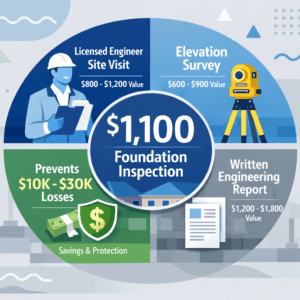
At Tri-County Foundation Repair, our required $1,100 structural engineering inspection provides:
- Licensed structural engineer evaluation
- Comprehensive elevation survey
- Detailed written report of issues and causes
- Specific repair recommendations
- Cost estimation for necessary work
- Documentation you own (even if you don’t hire us)
This investment is credited toward repair costs if you proceed with work. It’s the single most valuable $1,100 you can spend on your home.
Step 3: Get the Full Picture
The engineering report shows you exactly what’s wrong, what caused it, what needs to be fixed, and what it will cost. No more wondering, worrying, or guessing. You’ll have objective data from a licensed professional.
Step 4: Make an Informed Decision
With the engineering report, you can make a smart decision based on facts:
- Exact repair costs today
- Understanding of what happens if you wait
- Timeline for repairs
- Financing options if needed
- Documentation for negotiations if you’re selling
Step 5: Stop the Damage Progression
Foundation repair typically takes 2-3 days for pier and beam homes, 5-7 days for slab foundations requiring tunneling. That’s a week of inconvenience versus months or years of worsening damage and exponentially increasing costs.
The North Texas Reality Check
Here’s what you need to understand about foundation problems in Tarrant, Wise, and Parker counties: they are common, they are serious, they get worse over time, and they require professional repair.
There is no home remedy for foundation problems. There is no “wait and see” approach that works. There is no scenario where ignoring foundation issues saves you money.
The absolute best-case scenario if you do nothing is that you eventually pay 4-5 times what you would pay today, live with stress and declining quality of life for months or years, experience secondary damage throughout your home, and potentially lose equity in your property.
The worst-case scenario involves structural failure, major safety issues, inability to sell or refinance, and financial devastation.
Your Foundation Is Telling You Something—Listen
That crack above your door? The sticking doors? The sloping floors? These aren’t minor annoyances. They’re your home’s way of telling you it needs help.
After nearly two decades repairing foundations throughout North Texas, we can tell you with certainty: the homeowners who address foundation problems early spend a fraction of what those who wait eventually pay. The difference is consistently dramatic—$6,000 versus $25,000, $8,000 versus $38,000, $5,000 versus $43,000.
These aren’t scare tactics. These are the actual numbers from real cases we’ve handled in your area. The pattern repeats so consistently that we can predict with remarkable accuracy what waiting will cost.
If you’ve noticed foundation problems and have been putting off addressing them, today is the day to stop procrastinating. Every additional month you wait adds thousands of dollars to your eventual repair bill and increases the complexity and extent of damage throughout your home.
The question isn’t whether you’ll address your foundation problems. North Texas expansive clay soil guarantees they won’t resolve on their own. The question is whether you’ll address them at today’s cost or at next year’s cost—which will be exponentially higher.
At Tri-County Foundation Repair, we’ve helped hundreds of homeowners who wished they’d called six months earlier. We’ve never met a homeowner who regretted addressing foundation problems quickly. The universal regret is always the same: “I wish I hadn’t waited so long.”
Don’t be the homeowner who looks back twelve months from now and says, “If only I’d acted when I first noticed the problem, this would have cost $6,000 instead of $28,000.”
Your foundation problems are getting worse every day. The repair cost is increasing every week. The time to act is now.
KEY TAKEAWAYS
Cost Progression of Delayed Foundation Repairs:
- Foundation problems addressed immediately in North Texas typically cost $4,500-$6,500 requiring 4-6 pier repairs
- After 3 months of delay, costs increase to $8,500-$11,000 (89% increase) requiring 8-10 pier repairs plus drywall work
- After 6 months, costs reach $14,000-$18,000 (211% increase) requiring 12-15 piers plus plumbing stress repairs
- After 12 months, costs escalate to $22,000-$28,000+ (389% increase) requiring 18+ piers plus extensive secondary damage
- Total costs after one year including all secondary damage can reach $39,000-$63,000 versus $5,500 if addressed immediately
Why Foundation Problems Accelerate in North Texas:
- Expansive clay soil in Tarrant, Wise, and Parker counties changes volume up to 10% based on moisture content
- Seasonal wet-dry cycles compound damage rather than add to it linearly—each cycle affects a foundation weaker than the previous year
- Foundation settlement in one area creates differential stress that causes adjacent areas to fail faster than the original problem
- Foundation Performance Association confirms that expansive soil damage compounds exponentially over time rather than linearly
Secondary Damage from Delayed Repairs:
- Plumbing joints stressed by foundation movement develop leaks costing $2,500-$5,000 to repair after 6-12 months
- Drywall damage throughout home requires $2,000-$7,000 in repairs depending on delay duration
- Electrical issues from structural movement can cost $800-$2,000 to address
- Door and window adjustments or replacements add $1,500-$4,500 to total repair costs
- HVAC ductwork damage from foundation movement costs $1,000-$3,000 to repair
- Utility bills increase 10-20% ($300-$800 annually) due to air gaps created by foundation movement
Hidden Costs of Delaying Foundation Repairs:
- Home resale value reduces by $15,000-$25,000 even after repairs due to required disclosure of foundation history
- Insurance premiums may increase or policies may be non-renewed when foundation problems are documented but not repaired
- Pest entry through foundation cracks creates additional damage and treatment costs of thousands of dollars
- Water intrusion through foundation cracks causes mold growth and wood rot requiring $3,000-$15,000 remediation
- Inability to refinance prevents homeowners from capturing lower interest rates, costing $50,000+ over loan term
Foundation Repair Timelines:
- Pier and beam foundation repairs typically require 1 day for standard projects
- Slab foundation repairs with tunneling require 5-7 days depending on extent
- Structural engineering inspections cost $1,100 in Texas and are completed within 24-48 hours
- The $1,100 engineering inspection fee is credited toward repair costs at Tri-County Foundation Repair
- Post-repair engineering verification adds 1-2 business days to document work quality
Geographic and Soil Conditions:
- North Texas expansive clay soil creates foundation challenges not experienced in most other regions
- Tarrant, Wise, and Parker counties experience pronounced wet-dry seasonal cycles affecting foundations
- Foundation problems never stabilize on their own in North Texas due to ongoing soil moisture changes
- Both pier and beam and slab foundations experience accelerating damage without professional repair
FREQUENTLY ASKED QUESTIONS
Do foundation problems get worse over time?
Yes, foundation problems always get worse over time and never stabilize or improve on their own, especially in North Texas where expansive clay soil creates ongoing stress. Foundation damage accelerates exponentially rather than progressing linearly—each area of foundation failure creates stress on adjacent areas, causing them to fail faster than the original problem. In Tarrant, Wise, and Parker counties, seasonal wet-dry cycles compound existing damage with each year. A foundation problem costing $5,000 to repair today typically costs $8,500-$11,000 after three months, $14,000-$18,000 after six months, and $22,000-$28,000+ after one year. The Foundation Performance Association confirms that expansive soil damage multiplies over time due to cumulative stress cycles. Beyond direct repair costs, delayed foundation work creates secondary damage to plumbing, electrical systems, interior finishes, and HVAC ductwork, adding thousands to total repair expenses.
How fast do foundation problems progress?
Foundation problems in North Texas progress at an accelerating rate, not a steady linear pace. Initial foundation settling typically affects 4-6 piers or support points. Within three months, the problem spreads to 8-10 piers as differential stress affects adjacent areas. By six months, 12-15 piers require repair as damage cascades through the foundation system. After one year, 18 or more piers need attention along with structural beam replacement and extensive secondary damage. The progression rate depends on several factors: severity of initial problem, soil moisture conditions, seasonal weather patterns, drainage around the foundation, and foundation type (pier and beam versus slab). However, the pattern remains consistent—foundation problems accelerate rather than maintain a steady progression rate. Each wet-dry seasonal cycle in Texas (typically 2-3 cycles per year) compounds existing damage, making each subsequent cycle more damaging than the previous one. Homeowners who delay repairs by six months typically face repair costs 2.5-3 times higher than if addressed immediately.
Can you wait to fix foundation problems?
While physically possible to delay foundation repairs, waiting is financially devastating and never advisable in North Texas. Foundation problems in Tarrant, Wise, and Parker counties do not stabilize on their own due to expansive clay soil and seasonal moisture changes. Every month of delay increases repair costs by approximately 8-12%, meaning a $6,000 repair today becomes $18,000+ after six months and $25,000-$30,000 after one year. Beyond escalating foundation repair costs, waiting creates extensive secondary damage including plumbing leaks ($2,500-$5,000), interior damage to drywall and flooring ($4,000-$9,000), door and window problems ($1,500-$3,000), and potential HVAC ductwork issues ($1,000-$3,000). Additional hidden costs include higher utility bills (10-20% increase from air gaps), pest entry through foundation cracks, water intrusion causing mold, inability to sell or refinance the property, and reduced home value even after eventual repairs due to required disclosure. The universal experience of foundation professionals is that homeowners regret waiting—the cost difference between immediate action and delayed repair consistently ranges from $10,000-$40,000 depending on delay duration.
What happens if you don’t fix foundation issues?
Failing to fix foundation issues leads to progressive structural damage, extensive secondary problems, and eventual major financial losses. In North Texas, unfixed foundation problems continue worsening due to expansive clay soil and seasonal moisture cycles. Progressive damage includes: foundation settlement spreading from the original area to encompass larger sections of the home, structural beams and floor joists experiencing stress beyond design limits leading to failure, plumbing pipes stressed by foundation movement developing leaks under slabs or in crawl spaces, electrical conduit and wiring pulled and stressed creating safety hazards, HVAC ductwork separating at joints causing air leaks and efficiency losses, doors and windows becoming non-functional as frames shift out of square, and extensive interior damage to drywall, flooring, cabinets, and finishes throughout the home. Eventually, unfixed foundation problems make homes difficult or impossible to sell, prevent refinancing or obtaining loans, increase insurance premiums or result in policy non-renewal, reduce property values by $25,000-$75,000 or more, create actual safety hazards from structural instability, and in extreme cases lead to partial building collapse or condemnation. The longest case documented at Tri-County Foundation Repair involved a homeowner who waited 3 years to address foundation issues—what would have cost $7,200 initially ultimately required $67,000 in foundation repairs plus $38,000 in secondary damage remediation.
How much does it cost to fix foundation problems in Texas?
Foundation repair costs in Texas vary significantly based on problem extent, foundation type, and delay duration. For minor pier and beam foundation issues caught early, repairs typically cost $3,500-$6,500 requiring 4-6 pier adjustments and 2-3 days of work. Moderate pier and beam problems cost $7,000-$15,000 requiring 8-15 piers and 3-5 days. Extensive pier and beam repairs range from $15,000-$25,000 requiring 15+ piers, beam replacement, and 5-7 days. For slab foundations, minor repairs with 5-8 pilings cost $5,000-$9,000, moderate issues with 10-15 pilings cost $10,000-$18,000, and extensive slab repairs with 20+ pilings cost $18,000-$30,000 including tunneling and backfill work. These foundation repair costs don’t include secondary damage which adds substantially to total expenses: plumbing repairs $2,500-$5,000, extensive drywall work $4,000-$7,000, flooring repairs $3,000-$8,000, door and window adjustments $1,500-$3,000, and exterior brick repairs $2,000-$5,000. In Tarrant, Wise, and Parker counties, the required structural engineering inspection costs $1,100 and is credited toward repair costs if proceeding with work. Total project costs including all repairs range from $4,500 for minor early-stage problems to $50,000+ for severely delayed major foundation failures with extensive secondary damage.
Is foundation repair worth it?
Foundation repair is absolutely worth it and is essential for protecting your home investment in North Texas. Not repairing foundation problems costs exponentially more than timely repairs due to accelerating damage and secondary issues. The financial comparison is clear: a $6,000 foundation repair completed today prevents $20,000-$40,000 in total damage within 6-12 months. Foundation repairs increase or maintain home value—homes with documented foundation repairs and transferable warranties often sell for the same or higher prices than comparable homes without foundation history. Unrepaired foundation problems reduce home values by $25,000-$75,000 or more and make properties difficult or impossible to sell. Foundation repair is also required for: obtaining or maintaining homeowners insurance coverage, qualifying for mortgage refinancing or home equity loans, meeting FHA, VA, or conventional loan requirements when selling, and ensuring structural safety and livability of the home. In Tarrant, Wise, and Parker County where expansive clay soil guarantees ongoing foundation stress, professional repair with proper engineering is the only way to stop damage progression. The Titan Shield 2-Year Warranty on pier and beam repairs and lifetime warranty on slab pilings pushed to refusal provide long-term protection and peace of mind. Every homeowner who delays foundation repair regrets waiting—the universal experience is wishing they had acted immediately rather than allowing problems to multiply.
How long can you live in a house with foundation problems?
You can technically live indefinitely in a house with foundation problems, but quality of life deteriorates progressively and safety risks increase over time. Early-stage foundation problems (first 3-6 months) create annoyances like sticking doors, minor cracks, and aesthetic issues but remain generally safe. Mid-stage problems (6-12 months) cause functional issues including doors that won’t close, windows that won’t open, visible floor slopes, and gaps creating air infiltration and higher utility bills. Advanced foundation problems (12+ months) create serious livability concerns including plumbing leaks from stressed pipes, electrical hazards from pulled wiring, pest entry through foundation cracks, water intrusion during rain, HVAC inefficiency from damaged ductwork, and difficulty using doors and windows throughout the home. In extreme cases (2+ years without repair), foundation failure can create actual safety hazards including structural instability, severe plumbing failures causing water damage, electrical shorts creating fire risks, and in worst cases partial structural collapse. Most homeowners with advancing foundation problems report significant stress, embarrassment when hosting guests, difficulty sleeping due to worry, and declining quality of life. While foundation problems rarely force immediate evacuation, living with worsening foundation issues means accepting progressive deterioration of your home, declining property value, increasing repair costs, and escalating safety risks. In North Texas where foundation problems accelerate due to expansive clay soil, addressing issues promptly rather than living with them indefinitely is the only financially and practically sound approach.